

Tokenized Deposit Networks: A Practical Guide for the Banking C-Suite
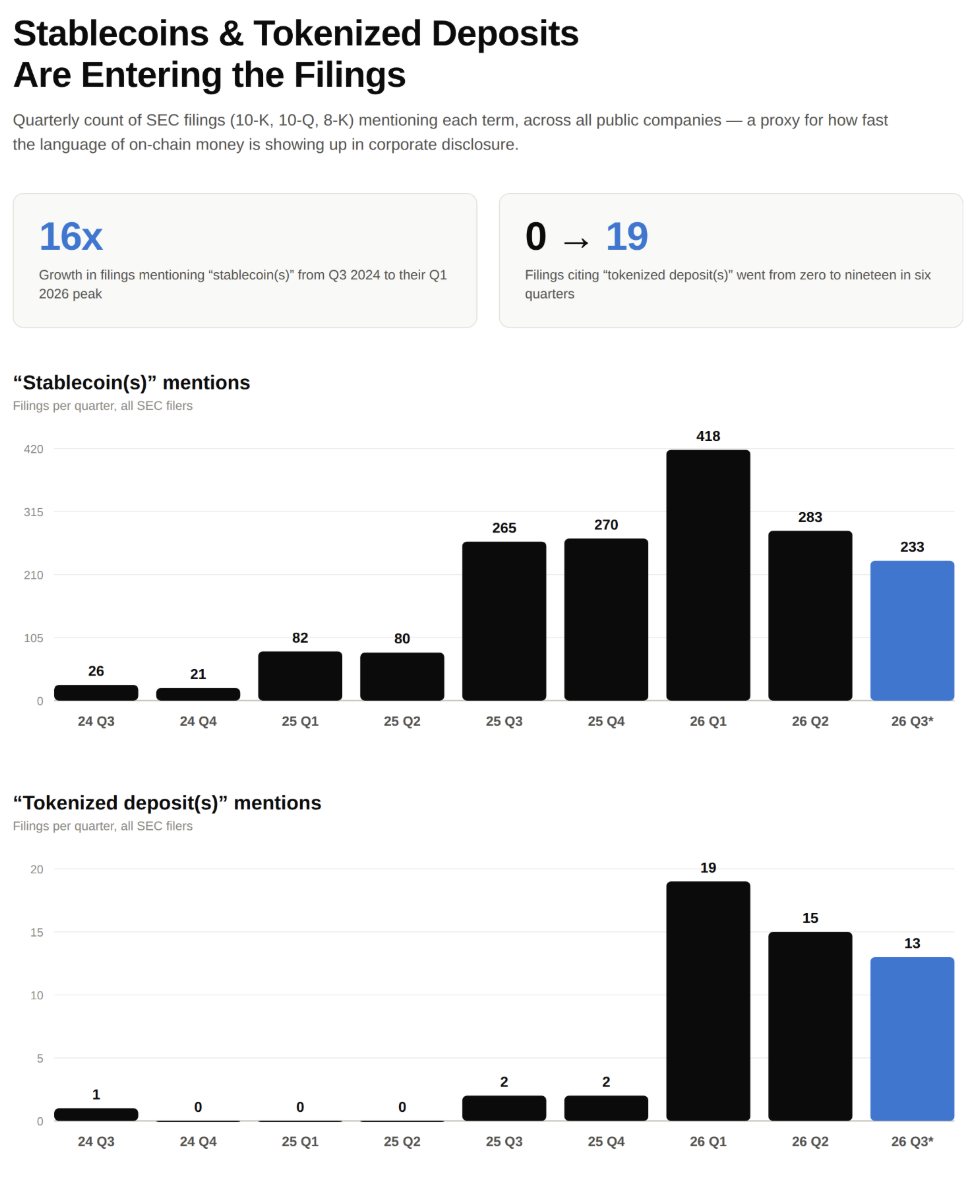
Strategic interest in tokenized deposits surged in 2026, following huge interest in stablecoins in 2025
- |
- Written by Nick Elledge, COO & Co-Founder of Stablecore

Strategic interest in tokenized deposits surged in 2026, following huge interest in stablecoins in 2025. The rise of payment stablecoins and the bipartisan passage of the GENIUS Act in July 2025 naturally led financial institutions to seek digital dollars they could keep on their own balance sheet and use for lending in the fractional reserve banking system.
Recent regulatory clarity has helped. On April 9, 2026, the FDIC proposed a rule confirming that deposit insurance “does not depend on the technology or recordkeeping used to record a bank’s deposit liabilities.” In plain terms, a tokenized deposit is treated exactly the same as the deposit sitting in a bank’s core today. That clarity has supercharged tokenized deposits as a hot item for bank technology roadmaps. Below, we unpack what bank executives need to know.
Tokenized Deposits Can Mean Different Things
It is easy to get confused by the term “tokenized deposit.” The term is often used interchangeably to describe three different models, each carrying different implications for banks.
1. Intrabank settlement networks (e.g., CUBIX and formerly Signet and Silvergate Exchange Network) move deposits between clients of the same bank, 24/7, because they are simple book transfers with no reserve settlement involved. Despite sometimes having blockchain branding, these are modern, high-speed databases. No distributed ledger is required.
2. Intrabank tokenized deposits (e.g., JPMorgan’s JPMD) place a “mirror” deposit token directly onto a blockchain like Base (a leading Ethereum Layer 2 “L2” blockchain), enabling atomic settlement between a deposit and other tokenized assets, as long as both parties bank with the same institution. It is real infrastructure, but does not scale past the issuing bank’s own client base. For the handful of global banks moving money for multinational clients, there are clear benefits such as longer banking windows, faster settlement, and better traceability.
3. Interbank tokenized deposits allow any participating bank to send or receive tokenized deposits from another financial institution. Multiple networks are competing to build out tokenized deposit networks in the US. A key architectural decision each must make is how and when to settle with bank reserves through Fed master accounts. Some networks plan to tokenize each bank’s own deposits (i.e., Bank A Coin, Bank B Coin) and some plan a single universal deposit coin.
The 2026 Network Map for Regional and Community Institutions
Money-center banks have the scale to answer the tokenized deposit question for themselves using intrabank (model #2 above). JPMorgan’s Kinexys platform, formerly Onyx, processes more than $7 billion a day in wholesale tokenized deposit transfers, and over $7 trillion since inception. Wells Fargo successfully uses tokenized deposits for US to UK expanded banking windows and faster settlement. Citi Token Services runs live cross-border cash management for its own institutional clients. HSBC’s tokenized deposits have their own webpage advertising that reads: Take your treasury into tomorrow: Instantly move and manage your funds globally, so you're ready for what's next. Designed for businesses with international treasury needs - we're making real-time treasury a reality.
Regional and community institutions without global scale need interbank (option #3 above) and now have their own doors to walk through.
|
Network Name |
Key Banks Named |
Blockchain and Custody |
Key Leadership |
Announced |
|---|---|---|---|---|
|
Cari Network |
Huntington National Bank, First Horizon Bank, M&T Bank, KeyBank, Old National Bank, SouthState Bank, Atlantic Union Bank, Bank of Vernon, ConnectOne Bank, FNBO (First National Bank of Omaha), Glacier Bank, MidFirst Bank, Raymond James Bank, Southwest Heritage Bank, and Washington Trust Bank ~30 banks had joined as of mid-2026. |
Prividium: a private, permissioned Layer-2 built on the ZKsync stack, anchored to Ethereum for settlement/security via zero-knowledge proofs. |
Gene Ludwig (CEO), Louie Giacomini (COO), Phoebe Kunitomi (Cofounder) |
18 February 2026 |
|
Project Keystone |
Citizens, Fifth Third, Huntington, KeyBank, M&T Bank named at launch |
N/A |
Jon Briggs, Jon Eisenstein, FIS leaders |
30 April 2026 |
|
The Clearing House On-Chain Money Initiative |
16 named at launch: Bank of America, BMO, BNY, Citi, Citizens, Fifth Third, HSBC, Huntington, J.P. Morgan, KeyBank, PNC, Regions, Santander, TD Bank U.S., Truist, U.S. Bank, and Wells Fargo. |
N/A |
David Watson, President & CEO, The Clearing House. Sal Karakaplan, Chief Strategy Officer, TCH |
5 June 2026 |
|
The Hazel Network |
A single token, Avit, that acts as a tokenized deposit inside member banks and automatically converts to a compliant stablecoin outside the network |
Ethereum mainnet. Vantage Bank is the settlement bank / correspondent. Custodia issues the token's stablecoin, holds segregated GENIUS Act reserves, and manages custody of cryptographic keys and on-chain addresses. |
Caitlin Long (CEO of Custodia Bank), Jeff Sennet and Shawn Main (Vantage Bank) |
30 June 2026 |
|
DTX by IBAT |
More than 60 banks are backing the initial pilot for the IBAT DTX tokenized deposit network |
N/A |
Christopher Williston, President & CEO, IBAT, leads the initiative. Julie Courtney, Anne Balcer |
22 July 2026 (tech partners announced) |
|
BankChain Alliance by State Associations |
N/A |
N/A |
Interim Board Chair Kathy Kraninger, interim CEO Kim Askwith |
25 August 2026 |
*NB: Stablecore does not own or have interest in any of the tokenized deposit networks above; Stablecore is an enablement and implementation partner to such networks.
It’s worth noting that other blockchain networks like Arc from Circle and Tempo from Stripe are likely substitutes for bank-owned tokenized deposit networks in the future.
Why Are Tokenized Deposits Useful?
Executives have asked whether banks are likely to need tokenized deposits and stablecoins if traditional rails continue to improve. There is no doubt that if traditional payments rails (like wires, RTP, ACH, and Zelle) improved significantly, they would take away many of the use cases of tokenized deposits and stablecoins.
Ten key factors impact choice of payment rail today:
- Speed
- Cost
- Customer protection
- Fraud/scam prevalence
- Infrastructure requirements
- Cross-border support
- Availability
- Ease of use
- Customer interest
- Rewards and incentives
The current payment rail options include wire transfers, credit cards, RTP from The Clearing House, stablecoins, FedNow, debit cards, and ACH.
The key advantages of blockchain-based transactions in banking continue to be:
- Faster settlement: Enables near-instant transactions, reducing delays in areas like securities and cross-border payments.
- Programmable payments: Uses smart contracts to automate transactions (e.g., releasing funds upon delivery confirmation).
- Digital asset integration: Serves as a settlement layer for tokenized securities and blockchain-based markets.
- Immutable transactions: Creates a permanent, tamper-proof record, as the transactions are recorded on blockchain infrastructure designed to be tamper-resistant, creating a durable audit trail.
- Improved liquidity management: Helps corporations move funds efficiently across accounts, financial institutions, and jurisdictions.
* [Source: NACHA]
The use cases with significant adoption right now will not revert to other rails once put onto blockchains. They include:
- Crypto market plumbing: liquidity, collateral, trading settlement
- Tokenization of Wall Street: RWA settlement, collateral, DvP
- Treasury and B2B cross-border settlement
- Payouts and cross-border remittances
- Trade finance and embedded credit
- Dollar access and FX hedging abroad
- Stablecoin rails at major payments giants
- Agentic commerce and internet-native micropayments
Why Banks are Likely to Need Both Stablecoins and Tokenized Deposits
Most executives leading the tokenized deposit networks acknowledge that tokenized deposits are not an “either/or” choice for banks. The reason is clear if we unpack the structural difference between stablecoins and tokenized deposits, which are different animals and serve different purposes in the ecosystem.
Stablecoins are issued by non-bank entities under the GENIUS Act and backed one-to-one by high-quality liquid assets - primarily U.S. Treasury bills. They function as bearer instruments, the same legal category as physical cash or a traveler’s check. Whoever holds the token owns the value.
Stablecoins do not have the same bank reserve settlement requirements as deposits. They settle instantly on public or private blockchains, 24/7, without needing to move bank reserves. That non-reserve settlement is one reason why stablecoins move faster than wires and other traditional payment rails. That is why some corporate treasurers and fintechs will keep choosing them over tokenized deposits, and both solutions are likely to co-exist.
Tokenized deposits are commercial bank money, in nearly every legal respect the same as a demand deposit account, recorded on a blockchain instead of a core ledger. Unlike stablecoins, they are account-based, not bearer instruments. Think of them as a faster, programmable version of ACH or wire transfer, with ownership recorded on a ledger the bank still controls.
Stablecoins have enjoyed a significant head start for adoption. They are not a theory. They exist today, with trillions in transaction volumes. They have survived multiple “crypto winters”. Tokenized deposits, by contrast, are just now emerging. The scale and always-on liquidity stablecoins already have is not there yet.
Stablecoins also carry a strategic weight for the US Treasury that tokenized deposits do not. Because the GENIUS Act requires 100% reserve backing, issuers have become large, price-insensitive buyers of U.S. Treasuries, helping fund the federal deficit. Tokenized deposits, which mostly fund bank lending instead, do not carry that same policy weight in Washington. That is another reason stablecoins are here to stay and why banks need a point of view on both instruments.
Six Key Risks for Tokenized Deposits
While firms are actively piloting various tokenized deposit and deposit token initiatives, there remain unresolved questions that may shape how these instruments scale across institutions and jurisdictions. Key open questions include:
- Identity and KYC/KYB portability: how banks can rely on customer verification across institutions without duplicative onboarding.
- Legal and accounting treatment of on-chain liability changes: how these frameworks apply when shared ledgers reflect changes in ownership of deposit claims independent of fiat settlement.
- Deposit insurance: how pass-through coverage applies in intermediated or omnibus token holding structures.
- Governance and standards: whether banks converge on common technical, legal, and operational frameworks or operate across fragmented ecosystems.
- Operational resilience: how liability from smart contract bugs, hacks, or outages will be addressed under existing legal frameworks.
- Liquidity and stability implications: how real-time, 24/7 deposit mobility will affect bank funding and liquidity management.
A Roadmap for the CEO and Board
Success in 2026 does not require tearing out your core banking system and starting over. The path forward is integration, not reinvention.
1. Assess Your Rails: Determine whether your current infrastructure can support digital assets and 24/7 liquidity today. Is it consolidated into one central hub to manage, and built for a frictionless client experience with intelligent routing? If not, you may be exposed to deposit flight and relationship disintermediation.
2. Partner for Speed: Building proprietary blockchain infrastructure is capital-intensive and slow, requiring specialized talent and millions of dollars. Most banks do not need to build that themselves. Partner with a regulated infrastructure provider that can overlay tokenization capability onto the core you already run.
3. Leverage the bank’s existing advantages: Banks hold what stablecoin issuers and fintechs cannot replicate – FDIC insurance, the ability to pay interest, and credit relationships built over decades. Banks can use these advantages to provide a better bundle.
Citi projects $100–140 trillion in annual bank-token (tokenized deposit) transaction turnover by 2030, from its June 2026 "Tokenization 2030" report. That is a foundational rewrite of how commercial money moves. Deposit flight rarely announces itself in advance; it shows up in a commercial treasurer’s decision to move working capital to a bank that already has modern infrastructure and rails.
Some banks are investing now in programmable rails to ensure commercial clients won’t find them somewhere else. The banks that own the next decade of commercial banking will be the ones that combine the safety and yield of the traditional deposit franchise with the speed of the programmable one.
Nick Elledge is COO & Co-Founder of Stablecore
Tagged under Tokenization; Feature; Feature3; Blockchain; Bitcoin; Cryptocurrency; Stablecoin; Compliance; Duties; Compliance/Regulatory;